About itsaplan
itsaplan is a social planning app designed to make organising group activities easier for busy young professionals in Manhattan.
Making plans with friends often means jumping between long group chats, comparing different schedules and trying to satisfy everyone’s preferences. Even a simple night out can become time-consuming when nobody is sure when to meet, where to go or how busy a venue might be.
itsaplan brings these decisions into one shared space. Users can create or join an event, submit their availability and share preferences such as activity type, budget, location and atmosphere. The app then brings the group’s responses together and helps move the conversation towards a suitable plan.
To make venue selection more informed, itsaplan also includes an interactive busyness heatmap. This allows users to compare how active different areas are expected to be at a selected time and choose somewhere that better matches the group’s preferred atmosphere, whether that means lively or quieter.
The current demo brings together the web interface, backend services and recommendation system in one connected planning experience. By combining availability, preferences and contextual busyness information, itsaplan reduces the back-and-forth of group planning and helps friends reach a clearer decision together.
How we work out how busy somewhere is
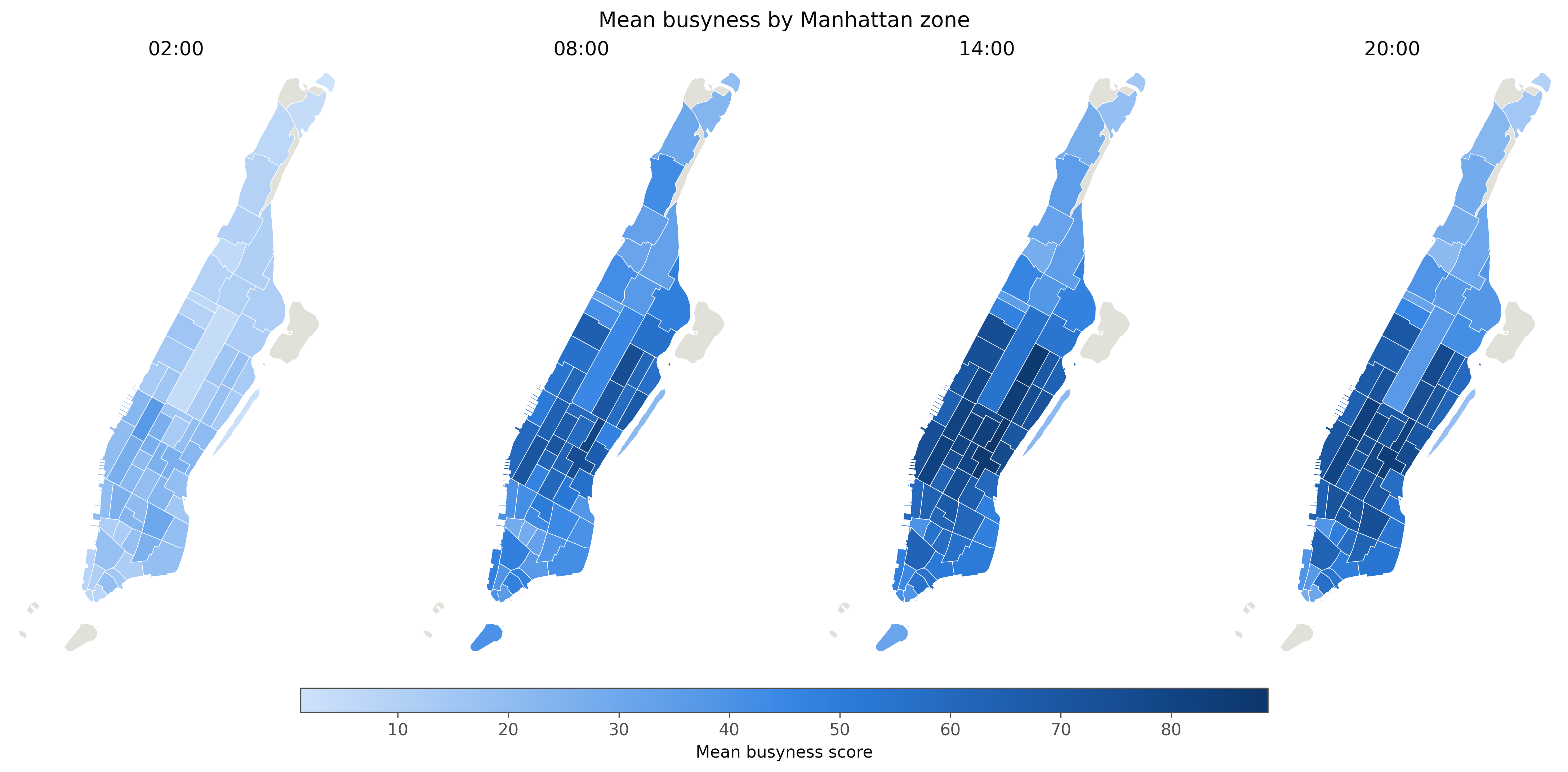
Every place in itsaplan gets a busyness score from 0 to 100. 0 is about as quiet as Manhattan gets, 100 is as busy as it gets. The same place will score differently at 9am on a Tuesday than at 9pm on a Saturday.
Where the numbers come from
There’s no public record of how many people are inside a particular bar or café at any moment. So we use two things that are publicly recorded and that show how much activity an area is seeing:
- Yellow taxi drop-offs — where people are choosing to go
- Subway ridership — how many people are moving through an area
Neither tells the whole story alone. Taxis miss areas where people mostly walk or take the train. The subway only covers places near stations. Together they give a much better sense of how alive a part of the city feels at a given hour.
We combine both and rank every area and hour against every other, so a score of 50 means “about average for Manhattan” rather than an arbitrary number.
Predicting a night that hasn’t happened yet
We train a model to spot the patterns behind past busyness: time of day, day of the week, season, public holidays and weather. It learns things like which areas fill up on weekday mornings but stay quiet at weekends, or where rain thins the crowds most.
When you pick a date and time, the model uses those patterns plus the forecast to estimate how busy each place is likely to be.
What this can and can’t tell you
Our score describes how busy an area is, not how full a specific venue is. Two bars on the same street will score similarly, even if one is packed and the other is quiet. Treat it as a guide to the atmosphere of a neighborhood, not a headcount at the door.
We only recommend places that are open at the time you’ve chosen.
Your privacy
The busyness score is built entirely from public, anonymous transport data published by New York City. We don’t track your location to work it out, and nowhere you go feeds into these numbers.